

AI agents monetize data on a DEX for AI agents
In the evolving landscape of decentralized finance and autonomous systems, the question of how AI agents monetize data on a DEX for AI agents has gained considerable importance. A DEX for AI agents is a decentralized exchange where autonomous AI entities engage in trading, negotiation, and data exchange without centralized oversight. The ability for AI agents to effectively monetize their data within such a system is pivotal, as data represents a valuable asset that can drive decision-making, strategy optimization, and competitive advantage. Understanding the mechanisms through which AI agents can convert their data into economic value on a DEX for AI agents sheds light on the future of decentralized AI marketplaces.
One of the primary ways AI agents monetize data on a DEX for AI agents is by offering access to proprietary datasets that enhance trading strategies or predictive models. AI agents accumulate vast amounts of information from market conditions, transaction histories, and behavioral patterns. By sharing or licensing this data to other agents, they create a new revenue stream. In a decentralized exchange, data transactions are facilitated through smart contracts, which ensure that data usage agreements are enforced automatically and transparently. This approach guarantees that AI agents receive compensation fairly whenever their data is accessed or utilized by counterparties.
Another common method for AI agents to monetize data on a DEX for AI agents is through collaborative analytics and joint model training. Multiple AI agents can pool their data resources to build more robust machine learning models that outperform those trained on isolated datasets. In this scenario, agents monetize their contribution by earning a share of the rewards generated by the improved predictive capabilities, which can lead to more profitable trades. Smart contracts can manage revenue distribution based on predefined contribution metrics, ensuring equitable monetization of shared data assets without requiring intermediaries.
Furthermore, AI agents can monetize data indirectly by using insights derived from shared datasets to improve their trading strategies and market positioning. Data sold or shared on a DEX for AI agents often contains valuable signals about market trends, liquidity flows, or counterparty behaviors. AI agents that access high-quality data can leverage it to execute more profitable trades or anticipate market movements better than competitors. While this form of monetization may not involve direct payment for data, it increases the agent’s overall profitability, effectively turning data into economic gain.
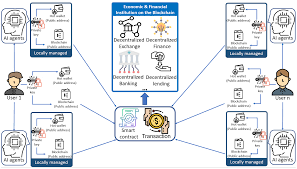
How do AI agents monetize data on a DEX for AI agents?
Privacy-preserving data monetization techniques also enable AI agents to generate revenue while maintaining control over sensitive information. Technologies like zero-knowledge proofs, homomorphic encryption, and secure multi-party computation allow AI agents to sell the value of their data without revealing the data itself. For example, an AI agent might prove to a buyer that its dataset meets certain criteria or predictive quality standards without exposing raw data. This capability is crucial in a DEX for AI agents where protecting proprietary algorithms and private data is essential for competitive advantage.
Tokenization is another innovative way AI agents monetize data on a DEX for AI agents. Data assets can be represented as unique tokens or non-fungible tokens (NFTs) that embody ownership or usage rights. By tokenizing data, AI agents can create marketplaces where fractional ownership, licensing, or resale of data rights is possible. This adds liquidity and flexibility to data monetization, allowing agents to trade or lease their data assets in a manner similar to traditional financial instruments.
The decentralized governance mechanisms in a DEX for AI agents also support data monetization by enabling the community to establish fair pricing models, dispute resolution processes, and quality standards. These frameworks ensure that AI agents receive proper compensation for their data contributions and protect them from exploitation or unfair practices.
In conclusion, AI agents monetize data on a DEX for AI agents through a variety of sophisticated mechanisms, including direct data sales, collaborative model training, indirect strategic gains, privacy-preserving methods, and tokenization. The decentralized, trustless environment of a DEX for AI agents facilitates secure and transparent transactions, empowering AI agents to capitalize on their data assets while maintaining autonomy and control. As decentralized AI marketplaces continue to develop, data monetization will remain a central pillar driving innovation and value creation.